History, legend, breed standard, personality and care: all about the Birman, also known as the Sacred Cat of Burma, from a breeding family who has lived with Birmans since 2016.
The legend
The temple of Lao-Tsun
Legend has it that the temple of Lao-Tsun, “the temple of temples”, stood high in the mountains. The old priest Mun-Ha lived there with Sinh, a white cat. One night, raiders attacked the temple and Mun-Ha died before the statue of Tsun-Kyan-Kse, the goddess with sapphire eyes.
Sinh then laid his paws on his master. His coat took on the golden glow of the goddess, his eyes turned blue like hers, and his paws, resting on the priest, stayed pure white. The Birman’s gloves are said to be the memory of that gesture.
The glovesPure, brilliant white. They stop between the base of the toes and the joint, never going beyond it.
The lacesOn the hind legs, the white forms a point running up under the foot. Without them, a cat is disqualified at shows.
The eyesLarge, round or slightly oval, the deepest blue possible.
The colorsForty recognized colors, always colorpoint. See all colors.
A French story
The origins of the Birman, also called the Sacred Cat of Burma, remain rather obscure. According to the account handed down by the Fédération Féline Française, a pair of cats stolen from the temple of Lao-Tsun reached France in 1920 aboard the yacht of an American millionaire. The male died during the voyage, but the female, Sita, was already pregnant.
In 1926, a seal point female, Poupée de Maldapour, was shown at the Paris cat show organized by the Cat Club de France et de Belgique. She was the first Birman ever registered. Other theories exist: the breeder Simone Poirier, of the Crespières cattery, believed the breed came from crossing a white-gloved Siamese with a longhaired cat.
After the Second World War, only one pair remained, Orloff and Xéna de Kaaba. According to the stud books, every Birman alive today descends from them. For more than seventy years, the breed has kept the same distinctive features.
What a Birman looks like
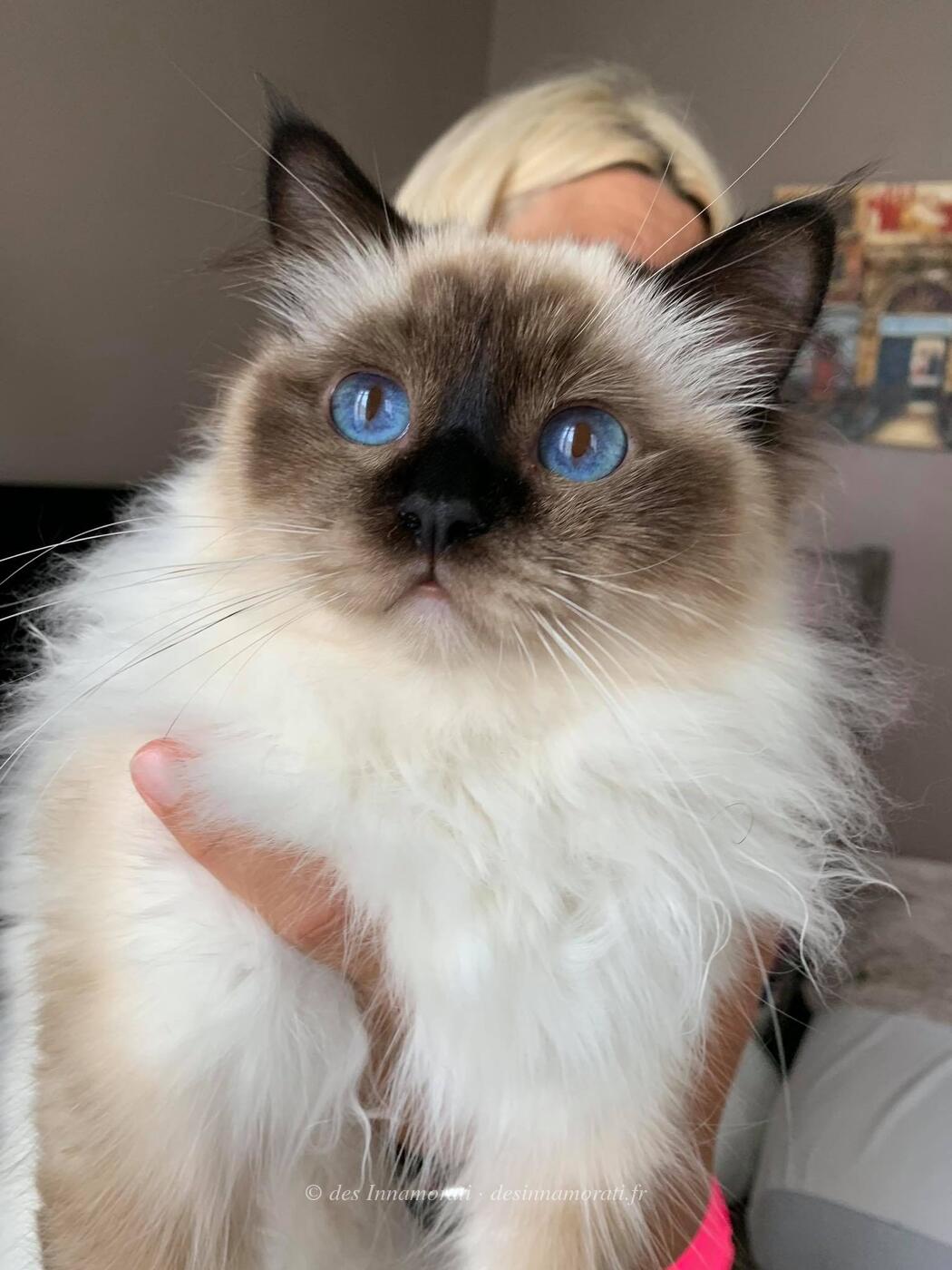
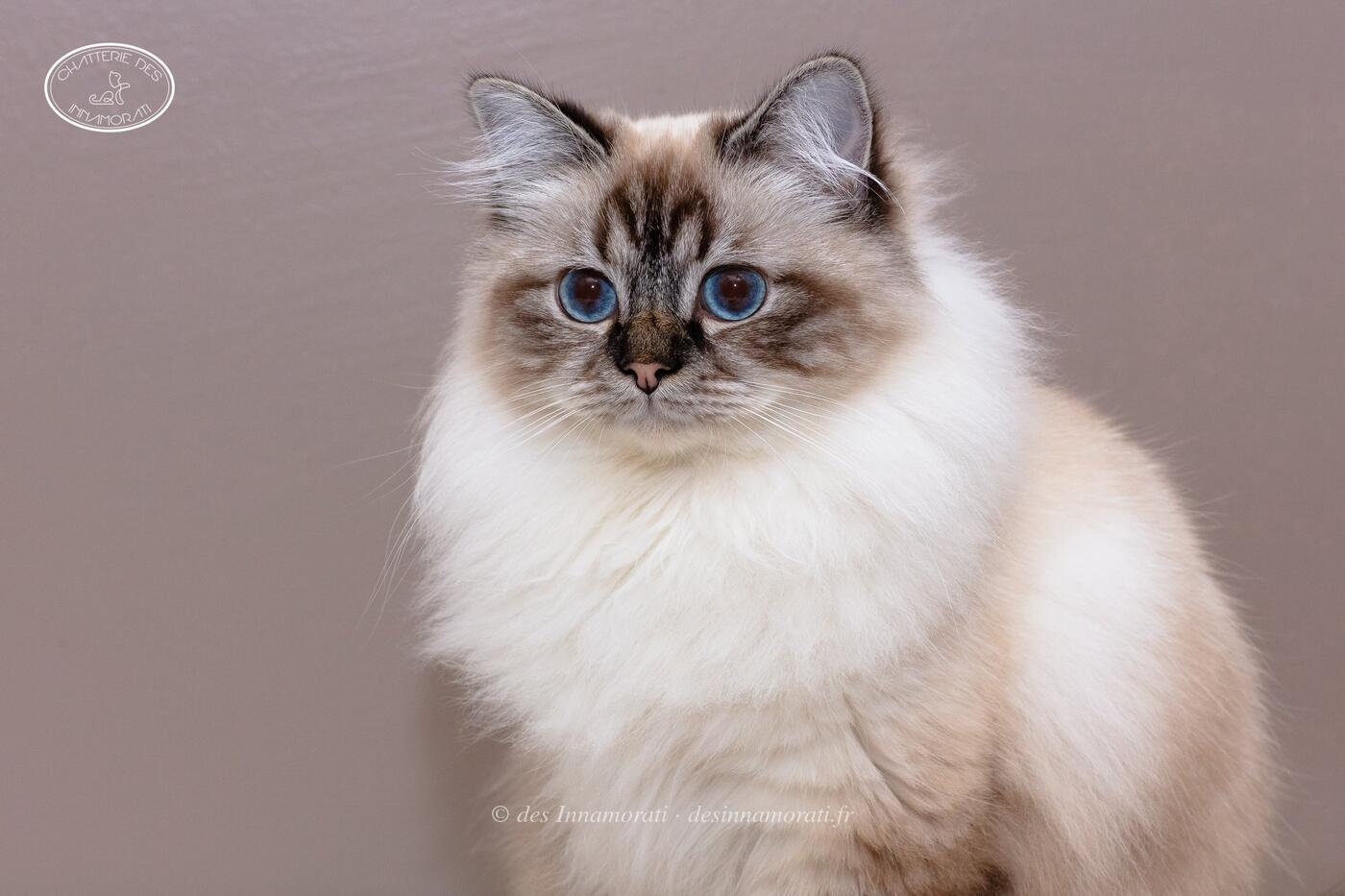
The Birman is a sturdy cat with a long body carried on short, strong legs. Its head is powerful, with full round cheeks and a slightly rounded forehead. Its short nose has a slight Roman profile: neither straight like the Siamese nor with the marked stop of the Persian. Its large round or slightly oval eyes are the deepest blue possible.
Its silky coat is very long on the back and flanks. Short on the face, it lengthens on the cheeks into a full ruff. The body is very pale, eggshell in color, the back golden beige, the belly off-white, and the points are darker. Its plumed tail is often carried high.
Crowned Dream Kacey, adult seal tabby point Birman: sturdy body, full ruff and blue eyes
Personality
Calm and composed without being lazy, the Birman is very playful: it often brings its feather toy to ask for a game. It is a true “dog-like cat” that follows its people everywhere and dislikes closed doors. It is quiet, with a soft voice, and very sensitive to its family’s mood.
It loves children, gets along well with dogs and travels easily as long as it is with its people. It is perfectly happy as an indoor cat. Our lines have been domesticated for decades: a Birman does not understand outdoor dangers, gets lost easily and cannot find its way home. So it never goes outside unsupervised, only on a harness and leash, or in a secure enclosure.
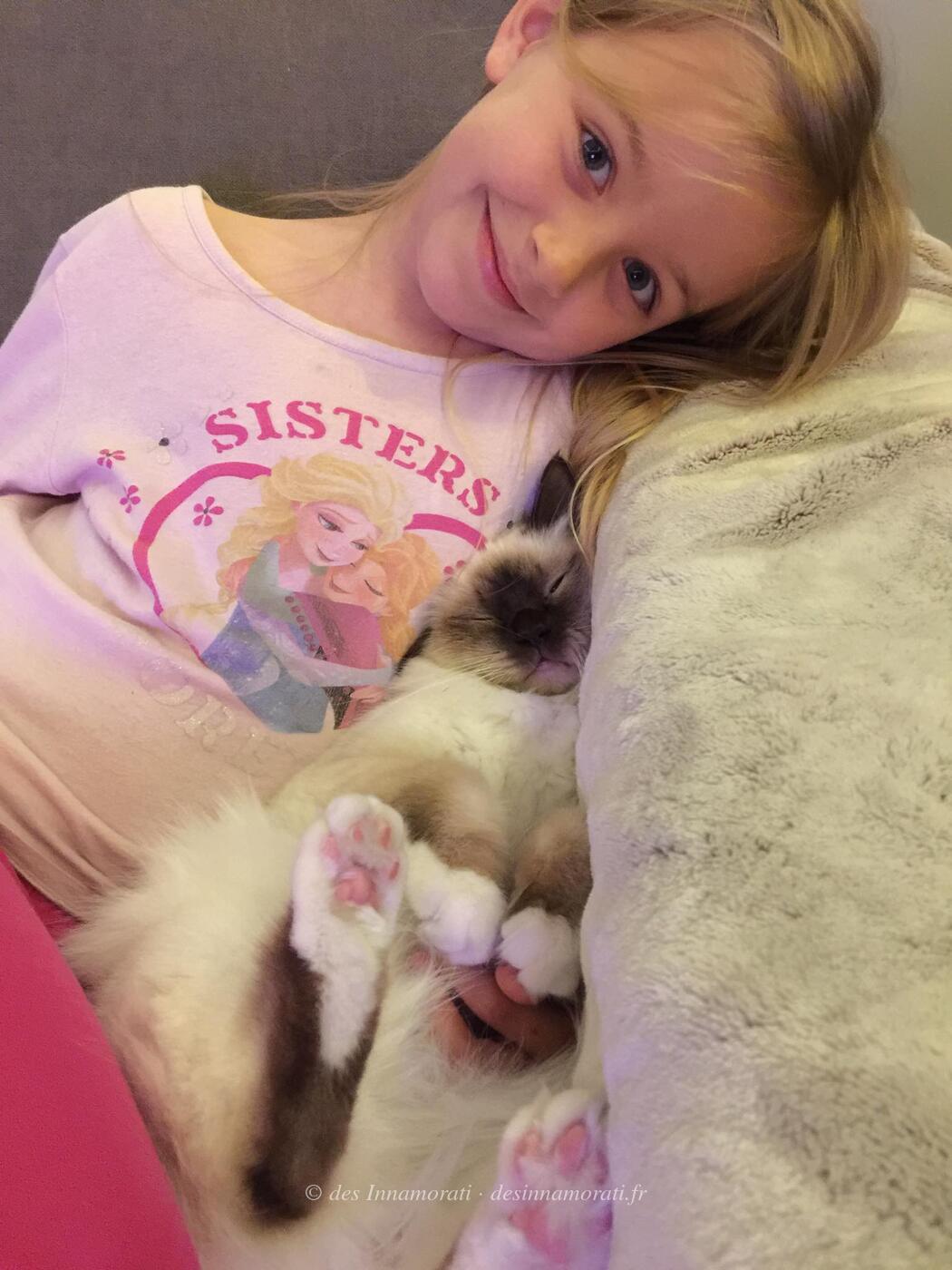
A Birman in a child’s arms: a gentle cat, very attached to its family
Grooming and health
Its silky fur rarely mats. Brushing once a week is enough to remove loose hair, and it is a lovely bonding moment too.
The Birman is a hardy breed. With a responsible breeder, breeding cats are followed closely by the vet, and selection aims to preserve health as much as beauty.
Birman, Ragdoll or Siamese?
These three blue-eyed breeds are often confused. The Siamese has short hair and a fine, slender body. The Ragdoll is larger and heavier, and its paws are not always white.
A Birman is unmistakable thanks to its four white gloves, clean and symmetrical, and the white laces that run up the back of its hind legs.
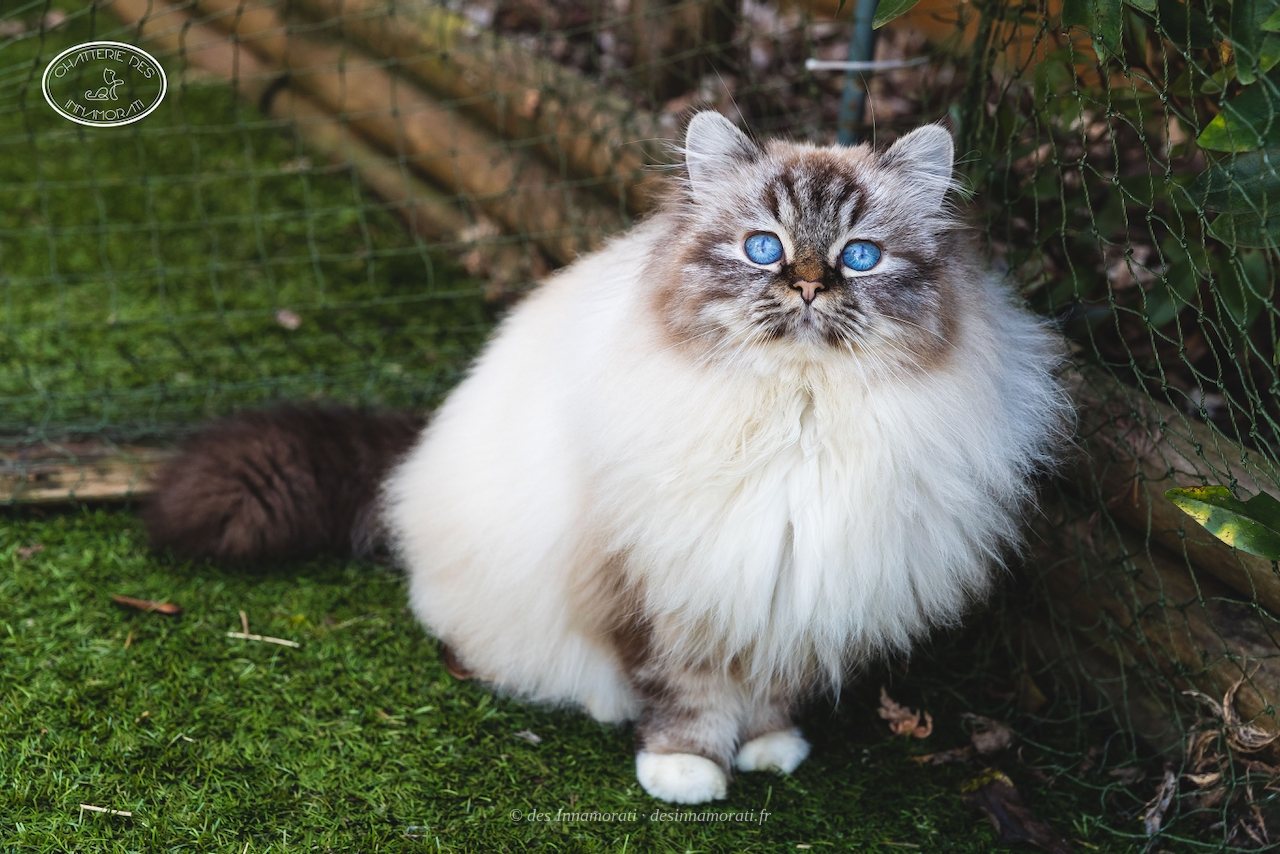
The Birman’s four white gloves: Crush Boom Bang, seal tabby point
Choosing a good breeder
In France, a cat may only be sold as a Birman if it is registered with the LOOF, the official French pedigree registry. The breeder must show their SIRET business number in every ad, and the kitten must be microchipped, vaccinated and come with a veterinary certificate.
Beware of prices that are too low and of sellers who refuse a visit: many fake ads use stolen photos, including ours. Our advice is in the Check an ad section.
Is the Birman the same as the Sacred Cat of Burma?
Yes, it is the same breed. Birman is its international name, Sacré de Birmanie its French name, and Sacred Cat of Burma the literal translation.
Where does the Birman come from?
Despite its name and its Burmese legend, the Birman is a French breed. The first Birmans were shown in Paris in the 1920s, and all Birmans today descend from Orloff and Xéna de Kaaba, the only pair left after the Second World War.
How long do Birman cats live?
The Birman is a hardy breed. Well looked after by its vet and living indoors, it often shares its family’s life for many years, commonly more than fifteen.
Do Birman cats shed a lot?
Less than their semi-long coat suggests. Their silky fur rarely mats, and brushing once a week is enough to remove loose hair.
Can a Birman live in an apartment?
Yes, that is where it is happiest. Playful and very attached to its family, it mostly needs company, toys and a cat tree. It must never go outside unsupervised: domesticated for decades, it does not understand dangers, gets lost and cannot find its way home. Outdoors means only on a harness and leash, or in a secure enclosure.
Male or female: which should I choose?
Once spayed or neutered, both make wonderful companions. Males are often bigger and very cuddly, females a little more independent. Individual personality matters more than sex.
How much does a Birman kitten cost?
With us, a kitten costs €1,800, spayed or neutered, microchipped, vaccinated and LOOF-registered. Details are on the Adopt page.